
Your child sits for hours with books open.
They attend tuition. Complete homework. Revise before exams.
And yet somehow, the marks still don’t reflect the effort.
For many parents, this becomes deeply confusing.
Because from the outside, it looks like the child is studying sincerely.
So naturally, the next assumption becomes:
- “Maybe they need more practice.”
- “Maybe they need stricter discipline.”
- “Maybe they just aren’t focused enough.”
But in many cases, the real problem is something far less visible:
The child may be studying without fully understanding.
And that changes everything.
At DiagnostIQ by Codex Education, this is one of the most common patterns we observe during diagnostic assessments across CBSE students.
Marks Don’t Always Reveal the Real Problem
One of the biggest misconceptions in education is that low marks automatically mean low effort.
But that isn’t always true.
In fact, many students work extremely hard and still struggle because their learning has become:
- memorized instead of understood
- procedural instead of conceptual
- familiar instead of transferable
This is why some children:
- solve examples correctly but freeze in unfamiliar questions
- remember formulas but cannot apply them independently
- revise entire chapters but still feel confused during exams
The issue is often not effort.
It is hidden misunderstanding.
And most school report cards are not designed to identify that.
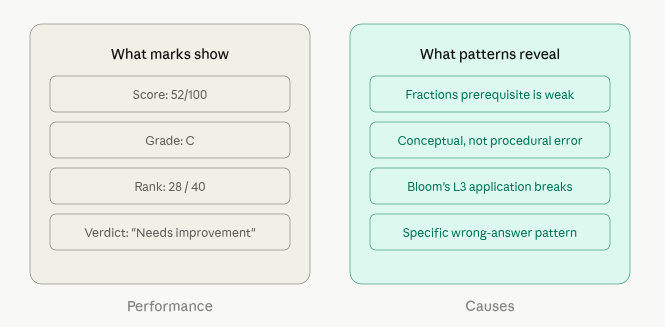
They only show outcomes.
Not causes.
This difference between outcomes and causes is exactly why DiagnostIQ assessments are structured differently from traditional tests.
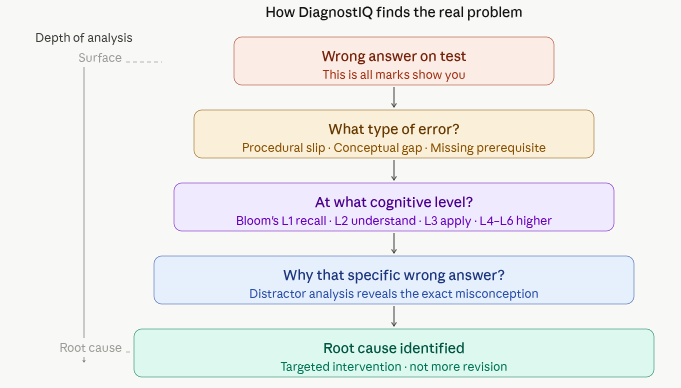
Instead of only measuring scores, we analyze:
• misconception patterns
• prerequisite concept gaps
• distractor selections
• application difficulty
• and Bloom’s cognitive levels (L1–L6)
This helps us identify not just whether a student got a question wrong — but why.
A Class 9 Problem Often Begins in Class 6
This is something many parents never get told.
A student struggling in Algebra today may actually be carrying an unresolved gap from Fractions or Ratios years earlier.
Because learning is connected.
For example:
Fractions → Ratios → Equations → Algebra → Application Problems
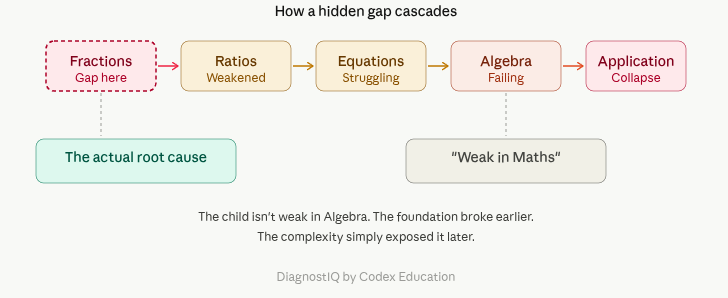
If the understanding breaks early in that chain, future topics begin resting on unstable foundations.
The child may continue moving forward academically — while silently carrying confusion underneath.
Eventually, the complexity increases. Application questions appear. Confidence drops.
And suddenly the child is labelled:
“weak in Maths.”
Even though the real issue may have started years earlier.
Why Hard Work Sometimes Stops Working
Parents often respond by increasing:
- study hours
- tuition
- worksheets
- revision
But if the underlying concept is misunderstood, repetition alone does not always solve the issue.
In fact, it can sometimes increase frustration.
This is why students often say things like:
- “I studied this already.”
- “I understood it while revising.”
- “I knew the answer at home.”
- “Everything went blank in the exam.”
What feels like inconsistency is often incomplete conceptual clarity.
The child recognizes the chapter.
But recognition is not the same as deep understanding.
This becomes especially visible in modern CBSE competency-based questions, where students are expected to apply concepts in unfamiliar situations rather than repeat memorized patterns.
What We Observed Through DiagnostIQ
This is exactly why we built DiagnostIQ at Codex Education.
Not to measure how much a child has memorized — but to understand where learning is breaking, why it is breaking, and what concepts are silently affecting performance.
Our diagnostic assessments for CBSE students from Classes 3–12 are designed around:
- Bloom’s Taxonomy (L1–L6 cognitive levels)
- misconception analysis
- prerequisite concept tracing
- distractor pattern analysis (understanding why a child picked a specific wrong answer)
- application-based reasoning
This allows us to identify whether a mistake happened because of a conceptual misunderstanding, a procedural error, a weak prerequisite foundation, or difficulty transferring understanding into application.
And that difference matters enormously.
For example, two students may both answer the same Algebra question incorrectly — but for completely different reasons.
One student may struggle because of a procedural calculation error.
Another may struggle because the prerequisite understanding of fractions and ratios was never fully developed.
Traditional tests usually record both outcomes the same way:
✘ Wrong Answer
DiagnostIQ separates the pattern behind the mistake.
Because each problem requires a different kind of intervention.
A Real Example
In one diagnostic assessment, a Class 7 student struggling heavily in Algebra appeared — at first glance — to have an “equation-solving problem.”
But deeper analysis revealed something more important.
The student could perform direct procedural steps when the format was familiar. However, the breakdown happened whenever fractions appeared inside multi-step equations.
Interestingly, the student consistently selected distractors that indicated procedural familiarity — but conceptual confusion around fraction equivalence and ratio transfer.
The root issue was eventually traced back to weak fraction operations from earlier grades, incomplete conceptual understanding of ratios, and difficulty applying concepts independently at Bloom’s Level 3 (Application).
In other words: the Algebra chapter was not the actual problem.
It was exposing a hidden foundation gap that had remained unnoticed for years.
This is why marks alone rarely tell the full story.
The Shift Happening in CBSE
CBSE assessments are increasingly moving toward:
- competency-based questions
- case studies
- application-focused patterns
- reasoning-driven formats
These questions expose conceptual gaps much faster than direct memory-based questions.
A child may memorize formulas, definitions, and methods — but still struggle when the question changes structure, concepts combine together, or reasoning is required independently.
This is one reason many students feel:
“The paper was harder than expected.”
Often, the difficulty is not the chapter itself.
It is the transfer of understanding.
What Parents Should Actually Observe
Instead of only asking:
“How many marks did my child get?”
it helps to ask:
- Which types of questions create confusion?
- Does the child struggle more in unfamiliar problems?
- Are mistakes repetitive across chapters?
- Does confidence collapse during application questions?
- Is the child memorizing or truly understanding?
These patterns reveal much more than marks alone.
Because marks show performance.
Patterns show causes.
Why Diagnostic Assessments Matter
Traditional tests usually measure outcomes.
Diagnostic assessments attempt to measure understanding.
At DiagnostIQ, parents receive:
• topic-level learning gap analysis
• subtopic-level performance mapping
• misconception indicators
• Bloom’s cognitive-level breakdowns
• prerequisite dependency tracing
• distractor analysis patterns
• and a guided parent consultation explaining what the report actually means
The goal is not to label children.
The goal is to understand them better.
Because improvement becomes much more effective when the actual problem is visible.
Final Thought
A child struggling academically is not always lazy. Not always careless. And not always “weak” in the subject.
Sometimes, they are simply carrying invisible learning gaps nobody identified early enough.
And the longer those gaps stay hidden, the heavier learning begins to feel.
That is exactly what DiagnostIQ was built to uncover.
We’re opening our first 200 diagnostic slots at no cost — a 35-minute assessment, a full learning gap report with misconception and prerequisite analysis, and a parent consultation call to walk through what it means.
What Does a DiagnostIQ Report Actually Show?
✔ Hidden conceptual gaps
✔ Weak prerequisite foundations
✔ Bloom’s-level performance analysis
✔ Application vs memorization patterns
✔ Misconception-based distractor analysis
✔ Topic & subtopic breakdowns
✔ Parent consultation with actionable clarity
Not just marks.
Clarity.
🎁 First 200 parent diagnostics complimentary.
📩 DM “DIAGNOSTIQ” or visit Codex Education to get started.
DiagnostIQ ✦ by Codex Education Not just marks. Clarity.